
Many people recognize the roadrunner because of the Looney Tunes cartoon, where a fast bird repeatedly escapes Wile E. Coyote while shouting “beep-beep.”
Popular culture turned that bird into a simple gag character whose main trait is speed. Cartoons present it as little more than a running joke that appears briefly, outruns danger, and disappears again.
Actual roadrunners show far more complexity and ability than that comedic version suggests. Greater Roadrunner, known scientifically as Geococcyx californianus, lives across dry regions of the southwestern United States and Mexico.
Ground-dwelling habits often surprise people since roadrunners belong to the cuckoo family.
Appearance resembles a small chicken more than a typical cuckoo, which adds to that surprise.
Roadrunners Are Built for Speed
Roadrunners rank among the fastest running birds in North America. Adults often reach speeds around 15 to 20 miles per hour, which allows them to pursue prey across open ground with remarkable efficiency.
Short bursts can become even faster during a chase, especially when a lizard or insect attempts escape through sudden movement.
Body structure strongly supports rapid running. Long and powerful legs generate strong strides that push the bird forward across dry soil, sand, and rocky ground. Lean body shape remains almost parallel to the ground during a sprint.
That posture reduces air resistance and helps maintain balance during fast movement. Long tail functions like a rudder that helps with steering and sudden turns.
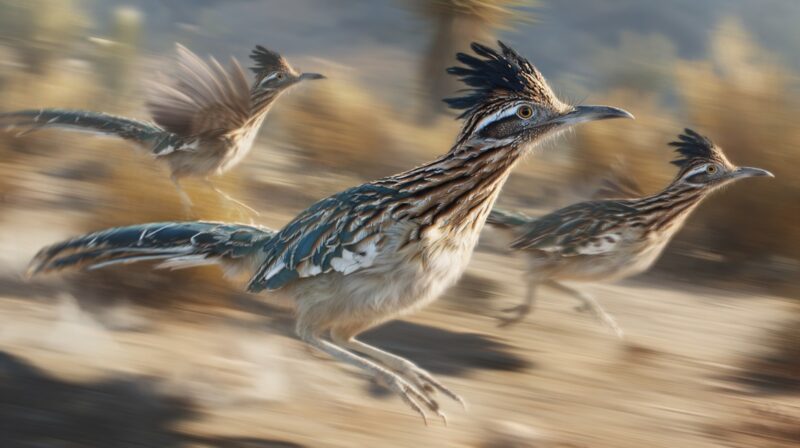
- Long legs are built for strong, repeated strides
- Lean body held low and forward during a sprint
- Long tail used for balance and directional control
- Lightweight body that allows fast acceleration
Ground speed plays a major role in daily survival. Many birds depend on flight for movement, yet roadrunners use wings only when necessary. Short flights may occur when escaping danger or reaching a perch, though running remains the primary method of travel.
Movement across desert terrain favors running instead of flying for several reasons.
Wings require energy and open air space, while ground travel allows quick changes in direction. Quick turns help during hunting and also allow sudden shifts in direction when danger appears.
Fast movement creates several advantages during daily activity. Prey animals such as lizards and insects rely on quick bursts of motion to escape predators.
Roadrunners often close the distance quickly and capture them before they reach shelter. Speed also helps avoid predators when crossing open desert areas that offer little cover.
Speed also supports long-distance movement during daily foraging. Roadrunners often patrol wide territories while searching for food, and rapid ground travel allows them to cover large areas efficiently.
They Are Fearless Predators
Aggressive hunting behavior places the roadrunner among the most capable predators in desert bird communities. Strong beak, quick reflexes, and sharp eyesight help locate and capture prey across dry terrain.
Diet includes a wide variety of animals, which allows the bird to adapt easily to changing food availability.
- Lizards
- Large insects such as grasshoppers and beetles
- Rodents
- Small birds and their eggs
- Snakes and other reptiles
One of the most remarkable behaviors involves attacks on rattlesnakes. Roadrunners may grab a snake and repeatedly strike it against rocks or hard ground until movement stops.
Powerful neck muscles allow repeated blows that weaken the prey. Persistence often leads to success even against animals that many predators avoid.
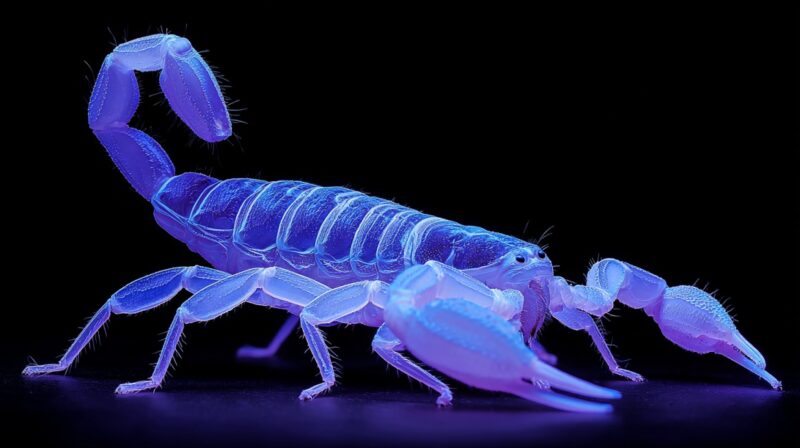
Dangerous prey rarely discourages these hunters. Tarantulas and scorpions frequently appear in their diet. Fast reactions help them avoid stings while delivering precise strikes with the beak.
Hunting tactics vary depending on the prey. Quick chases occur when prey attempts escape, while quiet stalking may occur when a potential meal rests or feeds nearby.
Observations recorded by Audubon reveal another surprising behavior. Roadrunners sometimes wait near cactus flowers or bird feeders where hummingbirds gather. Quiet patience allows a sudden ambush when a hummingbird approaches nectar.
Such opportunistic feeding habits increase survival chances in dry environments where food availability may change quickly.
Predatory behavior also supports ecological balance in desert regions.
- Control of insect numbers
- Reduction of small rodent populations
- Predation on reptiles such as lizards and snakes
Its role as a predator makes the roadrunner an important part of desert food chains.
They Are Perfectly Adapted to Harsh Desert Life
Roadrunners inhabit deserts and dry shrublands across the southwestern United States and Mexico. Conditions in those regions can become extreme. Daytime temperatures may rise very high, while nights often become surprisingly cold.
Survival requires a set of physical and behavioral adaptations that allow the bird to manage those conditions.
Water availability often remains limited in dry habitats. Roadrunners rarely need to drink because most hydration comes through prey. The moisture contained in the animals they eat supplies enough fluid to support daily activity.
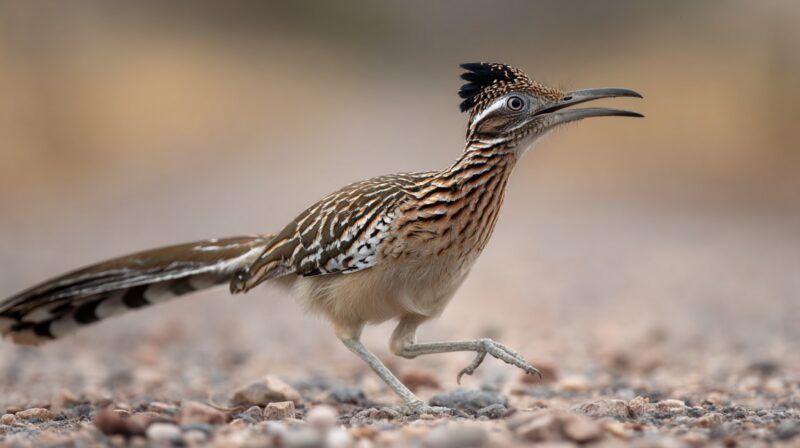
Feather patterns also contribute to survival. Mottled brown and white coloring closely matches dry soil, scattered rocks, and desert vegetation. Camouflage reduces visibility and allows the bird to approach prey quietly.
Protection against predators also benefits from this coloration. Blended feather patterns make the bird harder to detect while resting among shrubs or cactus.
Cold desert nights present another challenge. Body temperature may drop slightly during nighttime hours, which reduces energy use when environmental temperatures fall.
Morning sunlight helps restore body warmth after those cold periods. Roadrunners often perform a distinctive warming behavior during early daylight.
Feathers along the back lift upward, exposing dark skin underneath. Sunlight reaches that exposed skin and warms the body efficiently.
- Hydration is obtained mainly through prey
- Camouflage provided by mottled feather patterns
- Slight nighttime temperature reduction to conserve energy
- Morning sun exposure to restore body warmth
A combination of these traits allows roadrunners to thrive in environments that challenge many other animals.
They Are More Interesting Than Their Cartoon Reputation

The appearance of a roadrunner often surprises observers who expect a small bird similar to the animated version seen in cartoons.
Adult birds can reach nearly two feet in length when measured from bill to tail. Long tail, slender body, and shaggy crest produce a striking silhouette.
Bare skin patches behind the eyes show bright blue and red coloration. Colorful skin contrasts strongly with patterned feathers and becomes more visible during courtship displays or alert postures.
Sound also differs greatly compared with the famous cartoon “beep-beep.” Real roadrunners produce soft cooing calls that resemble sounds made by doves. Communication also includes a rapid bill-clattering sound created by snapping the beak repeatedly.
Foot structure produces another fascinating detail. Each foot has four toes arranged in a special pattern. Two toes point forward while two point backward. Movement across sand or dust leaves a very distinctive track pattern.
Tracks often appear in the shape of an X, which allows observers to recognize the presence of a roadrunner even when the bird remains out of sight.
Physical traits, vocal sounds, and unusual tracks show that roadrunners display far greater complexity than the simple cartoon character that many people remember.
Summary
Cartoon fame gave the roadrunner worldwide recognition, yet animated portrayals show only a small portion of the animal’s true abilities.
Careful observation reveals an impressive desert predator with remarkable speed and survival skills.
Fast running allows the pursuit of prey across open ground. Fearless hunting behavior includes attacks on animals as dangerous as rattlesnakes.
Strong adaptations support survival in extreme desert conditions that include intense heat and cold nights.