Ravens and crows belong to the Corvidae family, a group that also includes jays and magpies. Members of this family are known for intelligence, adaptability, and complex behavior.
Two of the most recognizable species in North America are:
- The Common Raven (Corvus corax)
- The American Crow (Corvus brachyrhynchos)
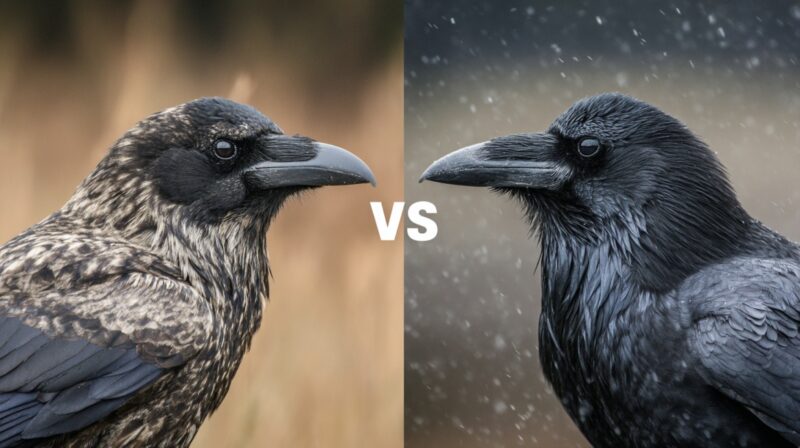
Common Raven and American Crow share large portions of North America, and both are black birds with long beaks. Overlapping ranges cause frequent confusion during birdwatching or casual observation. Both birds appear entirely black and possess similar body structures.
Dark plumage, strong bills, and comparable silhouettes make quick identification difficult for beginners.
Clear visual and behavioral clues help distinguish them quickly. Differences in size, tail shape, vocalizations, flight patterns, and social habits allow observers to identify each species with confidence.
Careful attention to these traits often reveals which bird is present even at a distance.
Size Difference is the First Quick Clue
Size offers one of the fastest ways to tell ravens and crows apart. Ravens appear noticeably larger than crows and often give a heavier, more powerful impression during observation.
Careful attention to body proportions and overall presence often reveals the correct identification even before smaller details become visible.
Common Ravens rank as the largest perching birds in North America. Adult birds reach an average body length close to 24 inches.
Large dimensions place them near the size of a Red-tailed Hawk, which often surprises observers who expect them to resemble crows more closely.
- Average body length around 24 inches
- Broad wings that create an expansive wingspan
- Thick body mass that appears dense while perched
- Strong bill built for tearing and manipulating food
@corvidresearch PSA: ravens are chonky. #CrowOrNo #Raven #Crow #Birds #Scientist #CrowExpert ♬ original sound – Kaeli Swift, PhD
American Crows appear smaller and lighter. Average body length measures close to 18 inches. Comparison with ravens reveals a bird that looks more compact and streamlined.
- Average body length around 18 inches
- Overall size about two-thirds that of a raven
- Narrower wings that give a slimmer flight profile
- Smaller bill that appears more delicate
Body shape also contributes to identification. Ravens often look bulky because their chest appears deeper and their neck looks thicker. Crows appear more balanced and lightweight in proportion.
Observers frequently notice the difference when both species appear in the same area. Even without direct comparison, a bird that appears unusually large for a crow often signals a raven.
Quick identification tip: A bird that appears unusually large and heavy for a crow likely indicates a raven.
Tail Shape in Flight
Tail shape offers one of the most reliable visual clues during flight. Spread tail feathers create distinct outlines that allow observers to distinguish the two species quickly.
Crow tail feathers remain relatively uniform in length. When spread during flight, the outer feathers and central feathers align closely, creating a rounded edge. Visual appearance resembles a fan.
- Feathers that remain nearly equal in length
- Rounded outline when the tail spreads
- Smooth, curved edge visible during gliding or flapping
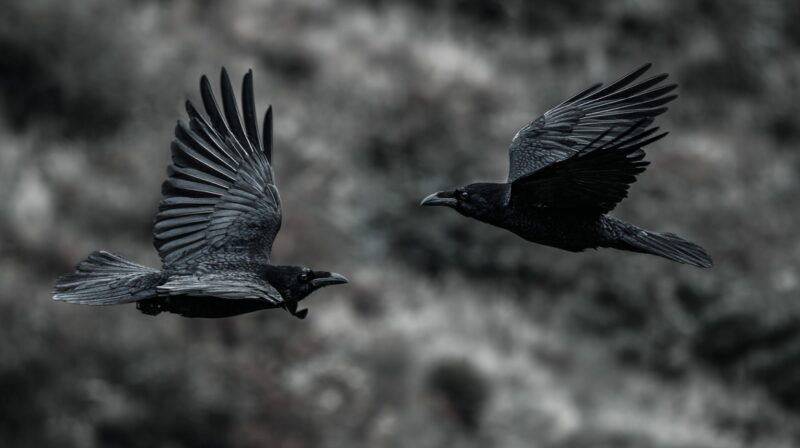
Raven tail feathers follow a different pattern. Central feathers extend noticeably longer than those along the edges. When the tail spreads, the shape forms a wedge or diamond.
- Longer central tail feathers
- Distinct wedge or diamond outline in flight
- A tail that often appears pointed when viewed directly behind
Strong light conditions often make this feature easy to notice. Even a brief view during flight can reveal the correct identification if the tail spreads clearly.
Quick identification tip:
- A fan-shaped tail indicates a crow.
- A wedge-shaped tail indicates a raven.
Vocalizations
Calls provide another dependable clue, especially when birds remain hidden among trees or travel high in the air. Sound often reveals identity before a clear visual view appears.
American Crow vocalizations produce the familiar “caw, caw.” Tone carries a sharper quality and a higher pitch. Calls often repeat several times in succession, especially when birds communicate with members of a nearby flock.
- Distinct “caw, caw” sound
- Higher pitch compared with raven vocalizations
- Short, repeated calls used during communication within groups
Common Raven vocalizations contrast strongly with crow calls. Sound often resembles a deep croak or harsh rattle. Lower pitch produces a rough and guttural tone that carries a very different acoustic character.
- Deep croaking or grating sound
- Lower pitch compared with crow calls
- Slower, more drawn-out vocal patterns
Advanced vocal ability also appears in ravens. Many individuals can imitate environmental noises and even mimic human speech. High intelligence within the Corvidae family allows ravens to produce a wide range of sounds.
Careful listening often allows birdwatchers to identify a raven or crow long before the bird becomes visible.
Flight Style and Behavior
Flight patterns create another helpful distinction between ravens and crows. Movement through the air often reveals identity even when distance prevents clear visual details.
Raven flight often appears buoyant and relaxed. Wingbeats occur slowly and may pause during extended glides. Strong wings allow ravens to take advantage of air currents, creating smooth and graceful movement across long distances.
Crow flight looks more direct and consistent. Wingbeats occur more frequently and maintain a steady rhythm. Movement usually follows a straight path with limited gliding.
Observation of flight behavior often provides a quick answer, especially when birds move across open sky.
Quick identification tip:
- Soaring, gliding, playful flight suggests a raven.
- Straight flight with steady flapping suggests a crow.
Social Behavior and Group Size
Behavior within groups also helps distinguish these birds. Social habits differ noticeably and often reveal identity without close inspection.
Crows display strong social behavior. Groups appear regularly in many environments, especially near human activity.
Flocks often travel together in search of food or gather in communal roosting areas.
- Small feeding groups during daytime
- Flocks traveling together across farmland or urban areas
- Massive evening roosts that may include hundreds or thousands of birds
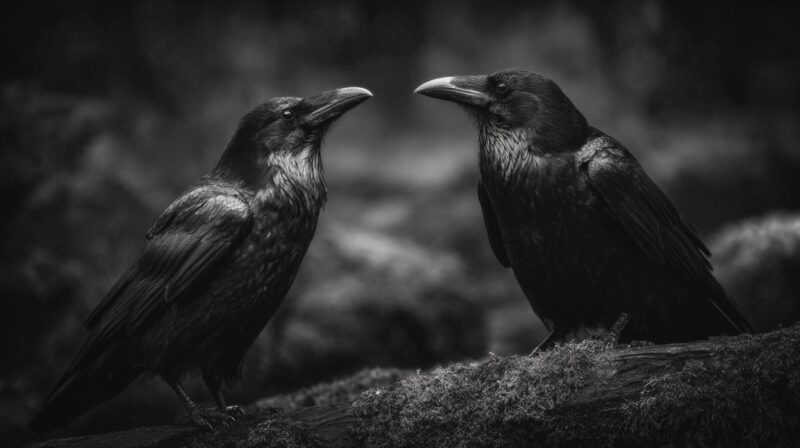
Ravens usually behave differently. Sightings often involve a single bird or a pair.
Long-term pairs maintain strong bonds and frequently remain together during daily activities.
- Solitary individuals traveling alone
- Pairs that remain closely associated
- Smaller gatherings compared with crow flocks
Group size therefore offers a strong visual clue. Large clusters usually signal crows, while isolated birds or pairs often indicate ravens.
Habitat and Range Differences
Both birds appear across large portions of North America, though habitat preferences show noticeable patterns.
Crows thrive in areas shaped by human activity. Cities, suburbs, farmland, and open fields all support large populations. Adaptability allows them to use a wide range of food sources and nesting sites.
- Urban neighborhoods
- Agricultural regions
- Parks and suburban areas
- Open countryside
Ravens historically occupied more remote regions. Forests, mountain areas, and rugged terrain supported many traditional populations. Recent expansion has allowed ravens to appear across many additional habitats.
- Mountain ranges and cliffs
- Forested regions
- Desert environments
- Arctic tundra
- Coastal areas
Overlapping distribution now occurs in many parts of North America. Shared territories often lead to confusion during observation, especially when quick identification depends on brief views.
Closing Thoughts
Clear differences make it possible to tell a raven apart from a crow with only a few quick observations. Careful attention to size, tail shape, calls, flight patterns, and social behavior often reveals the correct identification even during brief sightings.
Ravens usually appear larger, heavier, and more powerful. Wedge-shaped tails, deep croaking calls, and soaring flight patterns further distinguish them.
Crows appear smaller and more compact. Fan-shaped tails, sharp “caw” calls, and steady flapping flight create a different overall impression.