
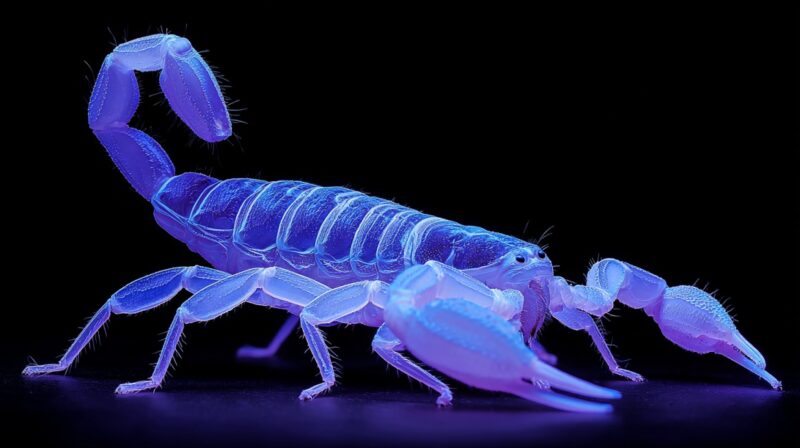
Scorpions gain attention due to a striking glow that appears under ultraviolet light. In darkness, a UV flashlight can reveal a bright blue-green glow covering the entire body. Fluorescence causes this effect, a process in which a substance absorbs ultraviolet radiation and re-emits energy as visible light.
Scientists noticed this phenomenon decades ago, and interest grew because almost every known scorpion species shows the same reaction.
Field researchers quickly discovered that ultraviolet lamps make nocturnal scorpion surveys far easier. In desert environments where little else glows, these dangerous desert animals, scorpions, become highly visible against the ground.
Curiosity about the glow has led scientists to examine both its chemical origin and its possible biological role. Research has clarified the chemical process responsible for fluorescence.
Debate continues about the biological reason for the trait.
Why Does This Happen and How is it Possible?
Interest in scorpion fluorescence grew after repeated observations during nighttime fieldwork. Biologists noticed that scorpions appeared vividly bright when ultraviolet lamps were pointed at the desert ground.
Glow occurs instantly once ultraviolet radiation reaches the scorpion’s body, creating a striking contrast against dark surroundings.
Careful study confirmed that the glow does not involve active light production.
Chemical reactions inside the exoskeleton convert invisible ultraviolet radiation into visible light. The resulting glow appears bright enough to detect even at several meters when a UV flashlight illuminates the animal.
The phenomenon of scorpion fluorescence
Exposure to ultraviolet light causes scorpions to emit a bright cyan or blue-green glow. Fluorescence within the outer shell produces the visible light.
Chemical compounds in the exoskeleton absorb ultraviolet radiation and release it as visible wavelengths.
Laboratory measurements have identified the range of ultraviolet wavelengths that activate the glow.
- Excitation wavelengths typically fall between 350 and 400 nanometers.
- Ultraviolet radiation within that range triggers fluorescent molecules in the cuticle.
- Visible emission commonly appears in cyan or blue-green wavelengths.
@bugswithmike Did you know that scorpions glow under ultraviolet light? It’s pretty cool, but wasn’t discovered until relatively recently. Two scientists both published their findings in 1954 about this cool phenomenon. #scorpion #glowinthedark #glow #fluorescent #bug #fyp ♬ original sound – Michael Porter
Reaction occurs immediately after ultraviolet radiation strikes the outer shell. Fluorescent molecules absorb energy and quickly release it as visible light. Process happens rapidly enough that the glow appears continuous while the ultraviolet light remains present.
Normal daylight or indoor lighting does not reveal the glow because fluorescent compounds require ultraviolet radiation to activate.
Darkness combined with UV illumination makes the glow highly visible. In a completely dark environment, a scorpion may appear as a bright glowing shape against a non-fluorescent ground.
How scientists detect scorpions using UV light
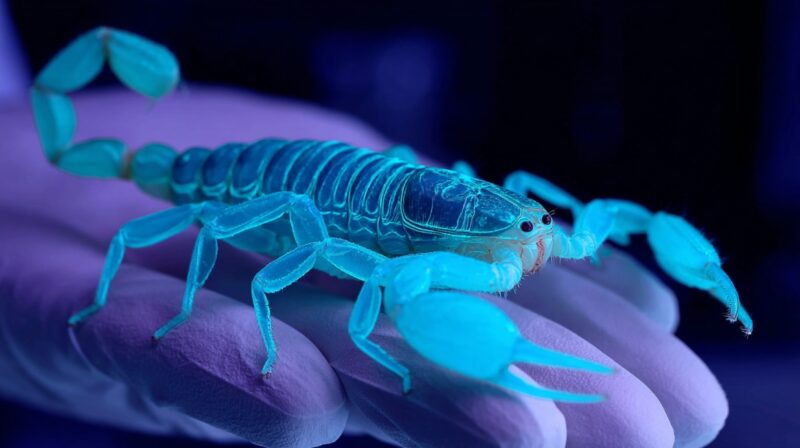
Nighttime field research often relies on ultraviolet flashlights because of the strong fluorescent response. Biologists conducting desert surveys realized decades ago that scorpions could be located far more easily using UV illumination.
Field observation usually involves scanning ground surfaces with handheld ultraviolet lamps. Glow produced by the scorpion cuticle contrasts strongly with soil, rocks, and vegetation that do not fluoresce.
- Glowing bodies remain visible at distances of several meters.
- Dark terrain rarely produces competing fluorescent signals.
- Detection becomes possible even when scorpions remain motionless.
Desert ecosystems often contain few materials that fluoresce strongly under ultraviolet light. Glowing scorpions therefore appear clearly against sand or rocky surfaces. Researchers frequently walk across desert terrain at night while sweeping UV flashlights across the ground.
Pest control professionals also rely on ultraviolet lamps when searching buildings and outdoor areas for scorpions. Glow visible under UV illumination reveals animals hiding in cracks, under debris, or near foundations.
A trait shared by nearly all scorpions
Fluorescence appears across almost every known scorpion species. Presence of the glow in species across many taxonomic groups indicates that fluorescent chemicals form a common component of the scorpion exoskeleton.
Observation across numerous species shows that the fluorescent response is extremely widespread.
- Almost every adult scorpion produces fluorescence under ultraviolet light.
- Glow appears across many families and genera of scorpions.
- Intensity may vary slightly between species but remains clearly visible.
Recently molted scorpions show little or no fluorescence. New exoskeleton material remains soft immediately after molting and has not yet formed the hardened outer layer containing fluorescent compounds.
Hardening of the cuticle gradually restores the fluorescent response. Once the shell becomes fully rigid, the hyaline layer inside the cuticle activates and the glow returns. Fluorescence then persists during the remainder of the scorpion’s life.
What Causes Scorpions to Glow?
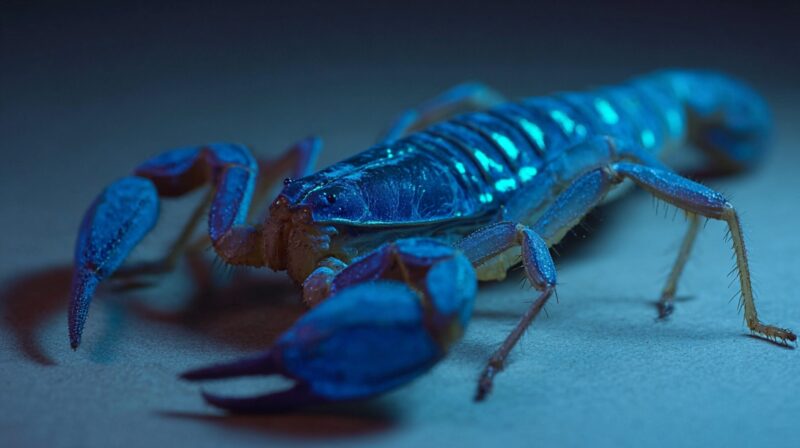
Scientific investigation has identified the chemical source of scorpion fluorescence. Research on scorpion cuticle chemistry revealed specific compounds embedded within the outer shell that respond strongly to ultraviolet radiation.
The structure of the exoskeleton plays a central role in producing the glow. Layers within the cuticle contain molecules capable of absorbing ultraviolet light and re-emitting visible wavelengths.
Fluorescent chemicals in the exoskeleton
The source of the glow lies inside the cuticle, the protective outer shell covering the scorpion’s body. Chemical analysis of the cuticle identified two fluorescent compounds responsible for most of the visible emission.
- Beta-carboline compounds are present within the cuticle matrix.
- 4-methyl-7-hydroxycoumarin is located in the transparent hyaline layer.
Location of these compounds occurs in a thin transparent layer called the hyaline layer within the exoskeleton. Hyaline tissue lies just beneath the outer surface of the cuticle.
Fluorescent chemicals embedded in that layer react strongly when ultraviolet radiation strikes the body. Resulting emission spreads across the entire exoskeleton, causing the whole animal to glow.
How fluorescence works
Ultraviolet light striking the scorpion activates fluorescent molecules in the cuticle. Molecules absorb high-energy ultraviolet photons that carry more energy than visible light.
Energy absorbed during that interaction quickly returns to the environment as lower-energy visible light. Emission commonly appears in wavelengths within the green or blue-green region of the spectrum.
- Ultraviolet photons strike fluorescent molecules in the cuticle.
- Molecules absorb the incoming energy and enter an excited state.
- Energy rapidly releases as visible light with lower energy than the absorbed radiation.
Process occurs through a passive chemical reaction rather than biological light production.
Bioluminescent organisms rely on metabolic reactions to produce light. Scorpion fluorescence requires only ultraviolet illumination and does not depend on internal chemical energy.
Development of the glow after molting
Molting represents a normal part of scorpion growth. During that process, the old exoskeleton splits open and a new cuticle forms beneath it.
Fresh cuticle remains soft and flexible immediately after molting. Newly formed exoskeleton material has not yet undergone the chemical hardening process needed to support fluorescence.
- Newly molted scorpions show dull coloration and little fluorescence.
- Cuticle remains flexible and lacks the hardened hyaline layer.
- Fluorescent molecules remain inactive until the shell stabilizes.
Hardening of the new exoskeleton gradually restores fluorescence. Formation of the hyaline layer and chemical stabilization of the cuticle activate the fluorescent compounds.
Glow then persists for the remainder of the scorpion’s life until the next molting event occurs.
View this post on Instagram
Closing Thoughts
Scorpions display a bright glow under ultraviolet light due to fluorescent compounds embedded within the exoskeleton.
Beta-carboline and 4-methyl-7-hydroxycoumarin within the hyaline layer absorb ultraviolet radiation and release visible blue-green light.
The mechanism of fluorescence is well documented through chemical analysis and laboratory experiments. Newly molted scorpions lack the glow until the cuticle hardens and the fluorescent layer becomes active.
Proposed explanations include light detection across the body, protection against ultraviolet radiation, communication between individuals, or a chemical by-product with no specific function.